




Diamond cut: asscher
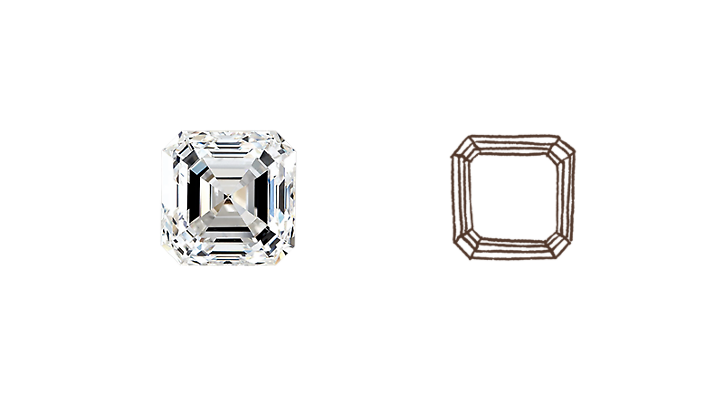
Discover the timeless allure and dimensional brilliance of Asscher cut diamonds, characterized by their distinctive step-cut facets and Art Deco elegance.
History
The Asscher cut diamond originated in 1902, created by the renowned Asscher Brothers of Amsterdam, who were pioneers in diamond cutting techniques. Initially known as the ”Square Emerald” cut, it gained popularity during the Art Deco era for its unique step-cut facets and geometric symmetry. Its resurgence in popularity in recent years is attributed to its timeless elegance and the revival of vintage-inspired jewelry trends, making it a sought-after choice for engagement rings and heirloom pieces alike.
Color
Unlike many other diamond shapes, Asscher cut diamonds have a unique facet arrangement that does not necessarily conceal a diamond’s natural color as effectively. Therefore, we advise to select a higher color grade, if you desire a colorless appearance in your Asscher cut diamond. For smaller diamonds, a color grade of G or higher is recommended to ensure optimal color appearance, while for larger stones exceeding 1.0 carat, opting for a color grade of F or higher can help achieve the desired colorless effect. This recommendation is based on the inherent characteristics of the Asscher cut, where the step-cut facets may not mask color as effectively as other diamond shapes, allowing any tint to be more visible to the naked eye. By choosing a higher color grade, you can ensure that your Asscher cut diamond exhibits a desirable level of brilliance and colorlessness, enhancing its overall beauty and appeal.
Clarity
When selecting an Asscher cut diamond, it is important to consider its clarity. This is because the cut features a large and open table facet, which makes any inclusions easily visible to the naked eye. To ensure that the diamond looks eye-clean, it is recommended to opt for higher clarity grades. If you are looking for an Asscher cut diamond with minimal visible inclusions, it is best to choose a clarity grade within the VS1-VS2 range or even higher. Diamonds in this range typically have few, if any, visible inclusions under normal viewing conditions, making them appear clean and impressive. For larger Asscher cut diamonds that exceed 1.0 carat, we recommend to consider diamonds with even higher clarity grades, such as VVS (Very, Very Slightly Included) stones. These diamonds have extremely minimal inclusions that are difficult to detect even under magnification, making them ideal for larger stones where clarity is especially important. By prioritizing clarity, you can ensure that your Asscher cut diamond looks visually stunning, with maximum brilliance and transparency. This enhances its overall beauty and value, making it a truly spectacular gemstone.
Cut
The cut of an Asscher diamond significantly affects how much it sparkles and shines. For maximum brilliance and overall visual appeal, it is important to find diamonds with optimal proportions. The depth percentage should be around 60% to 67%, and the table percentage should be within the range of 61% to 69%. Although the Gemological Institute of America (GIA) does not assign a specific cut grade for Asscher diamonds, sticking to these measurements can help you find a well-proportioned and beautiful stone. The quality of polishing and symmetry also play a vital role in an Asscher diamond’s overall appearance. We suggest choosing diamonds with polishing and symmetry grades ranging from Good to Excellent, depending on your budget and preference. Superior polishing and symmetry contribute to a diamond’s symmetry and light performance, enhancing its brilliance and visual appeal. By prioritizing these factors, you can ensure that your Asscher diamond sparkles and shines in an enchanting and captivating way.
Asscher cut diamond size chart
| MM | CARAT WEIGHT |
|---|---|
| 4.00 | 0.40 |
| 4.50 | 0.50 |
| 5.00 | 0.75 |
| 5.50 | 1.00 |
| 6.00 | 1.25 |
| 6.50 | 1.50 |
| 7.00 | 2.00 |
| 7.50 | 2.50 |
| 8.00 | 3.00 |
| 8.50 | 3.50 |
| 9.00 | 4.00 |
| 9.50 | 5.00 |
| 10.00 | 5.70 |
Asscher cut diamonds - cut guide
| EXCELLENT | VERY GOOD | GOOD | FAIR | POOR | |
|---|---|---|---|---|---|
| BORD % | 61 - 69 | 57 - 60 Eller 70 - 72 |
54 - 56 Eller 73 - 74 |
51 - 53 Eller 75 - 79 |
< 51 Eller >79 |
| DJUP % | 61 - 67 | 59 - 60.9 Eller 67.1 - 70 |
57 - 58.9 Eller 70.1 - 74 |
55 - 56.9 Eller 74.1 - 79 |
< 54 Eller >79 |
| RONDIST | Very Thin - Slightly Thick |
Very Thin - Slightly Thick |
Very Thin Till Thick |
Very Thin Till Very Thick |
Ex. Thin Till Ex. Thick |
| KULLETT | None | Very Small | Small | Medium | >Medium |
| RATIO | 1.00 - 1.03 | 1.00 - 1.03 | 1.04 - 1.05 | 1.06 - 1.08 | >1.08 |