




Fluorescence
What is fluorescence?
Fluorescence is a fascinating phenomenon observed in diamonds, in which the diamond emits visible light upon exposure to ultraviolet (UV) radiation. It can appear in various colors, such as blue, yellow, green, or white. When a diamond is exposed to UV light, some of the photons in the UV spectrum are absorbed by the diamond's atoms. These absorbed photons give energy to the diamond's electrons, causing them to move to higher energy levels within the atoms.
The debate about fluorescence
The topic of fluorescence is highly debated, which has divided the diamond industry into two camps. One side argues that fluorescence does matter and affects a diamond's appearance, while the other side claims that it does not. A third group believes that fluorescence does not provide new information or general characteristics about a diamond. They argue that the effect of fluorescence on a diamond can be either positive or negative, depending on the individual diamond.
Does it affect the diamond?
Diamonds are graded on a scale ranging from D (colorless) to Z (light yellow or brown). The color of a diamond affects its value and can be an essential factor when choosing a diamond. However, some diamonds with warmer colors can appear more white or colorless, thanks to a phenomenon known as blue fluorescence.
Blue fluorescence occurs when a diamond emits a blue glow when exposed to ultraviolet light. This can mask the yellowish tint characteristic of diamonds with lower color grades. One of the most famous examples is the Portuguese Diamond, an Asscher cut with a color grade of M. Despite its relatively warm color, the blue fluorescence gives the diamond a white appearance and effectively hides its yellow shade.
In summary, the blue fluorescence in diamonds can be a desirable feature, as it can enhance the diamond's appearance and make it appear more white or colorless.
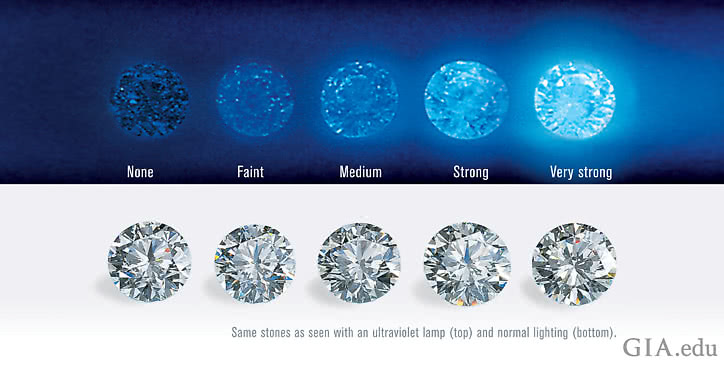
All of the diamonds shown above have been graded with an E rating for color, and they share identical attributes in terms of Carat, Clarity, and Cut. Experts conducted an experimental assessment without prior knowledge of the diamonds' fluorescence, and they found that most preferred the diamond positioned at the far right. This particular stone exhibited the most robust fluorescence, a deviation from the prevailing beliefs within the diamond industry.
The Gemological Institute of America (GIA) conducted an extensive study to investigate the impact of fluorescence on diamond appearance further. They presented thousands of diamonds to various groups, including diamond traders, retail staff, and consumers, and the study yielded precise results. Contrary to common assumptions, no definitive correlation exists between a diamond's perceived attractiveness and its fluorescence. The GIA's comprehensive survey revealed that only about 0.2% of diamonds with fluorescence were perceived as having a milky appearance. On the other hand, most diamonds exhibiting vital to medium fluorescence were considered superior and more aesthetically pleasing.
.png)
Does Fluorescent affect the price?
Diamonds with fluorescence are typically priced lower than those without. For instance, a diamond with a color grading of D-G and any level of fluorescence is typically less expensive than one without. However, this is not the case for diamonds with a color grading of H or lower. In fact, in some cases, diamonds of these grades with fluorescence may be priced even higher than those without it.
Our expert's advice
Fluorescence can affect how a diamond looks, but it improves its appearance in most cases. However, the diamond industry is quite conservative and cautious, so most dealers avoid diamonds with any degree of fluorescence. This is something that GIA also questions. They believe, just like we do that a diamond should be evaluated based on how it looks in daylight without considering its fluorescence. We advise you to purchase a diamond based on the criteria you want and not to pay too much attention to the diamond description. This may save you a few hundred dollars as a bonus. For instance, buying a diamond with a lower color but strong blue fluorescence might make the stone look whiter. If you have any questions about this, please contact us. You can also learn more about fluorescence at GIA.