




Diamond cut
Key to Maximum Sparkle
A diamond's cut determines how much it sparkles. This parameter, included in the 4Cs, describes how well the facets, i.e., the different parts of the diamond, are cut.
History
Diamond cutting can be traced back thousands of years. Perhaps the most revolutionary event occurred during the 15th century in Bruges, Belgium. Here, a brilliant cut was developed, aiming to maximize the diamond's beauty with optimal light reflection. Through symmetrical planes, the characteristic sparkle that characterizes well-cut diamonds is created.
What Does cut mean?
The cut of a diamond describes the quality of its facets, i.e., the different parts of the diamond. The cut is the most important factor in determining a diamond's brilliance; a good cut can make it shine and sparkle, while a poorly cut diamond can appear lifeless and dark. It is about not cutting the diamond too shallow or too deep. All diamond shapes have different ideal measurements.
_2 (1).webp)
How Light Affects Our Perception
Three Different Effects
1. Reflection
The part of light that is reflected directly towards the observer and does not travel into the stone.
2. Refraction
Depends on how light bounces or reflects in the stone; the better the proportions and cutting grade, the more light is reflected in the stone.
3. Dispersion
The transformation occurs when white light penetrates the diamond and is reflected out as light in various colors. This light is also known as "fire."
Diamond Anatomy
Below is the structure of a typical round brilliant-cut diamond. Each diamond is unique and has its own specific characteristics, so it is common to divide diamonds into different parts to better understand their structure and quality. The three main parts of a diamond are the crown, girdle, and pavilion. It is the relationship between these parts that determines the diamond's cut quality and how it is perceived. The beauty and brilliance of a diamond often depend on the balance between these three components, making it crucial to understand their relationship and how they affect both aesthetics and value.
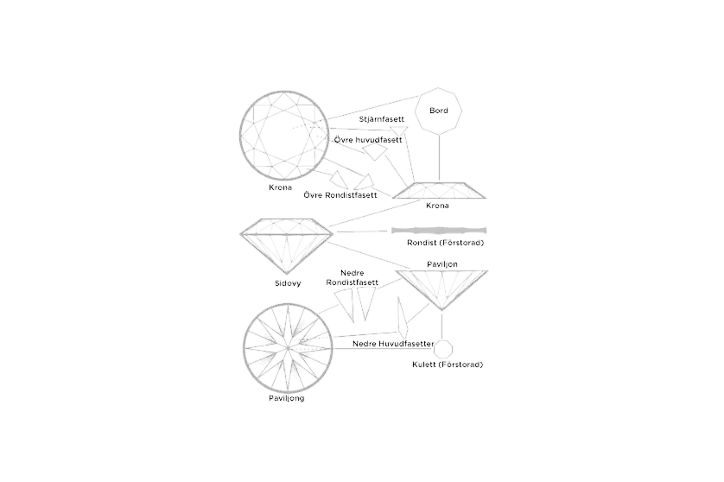
Diameter:
The width of the cut stone at its widest point.
Depth:
The percentage of height in relation to a diamond's diameter.
Table:
The largest cut facet at the top of a diamond. The size of the table is expressed as a percentage.
Pavilion:
The lower part of the diamond that begins at the girdle and ends at the culet.
Girdle:
The edge where the crown transitions to the pavilion. This part is also called a diamond's waist.
Crown:
The upper sloping part from the table that runs down to the girdle.
Culet:
The tip or the blunted bottom of a diamond.
Grading the cut
The cut is graded on a scale ranging from Excellent (ideal) to Poor.
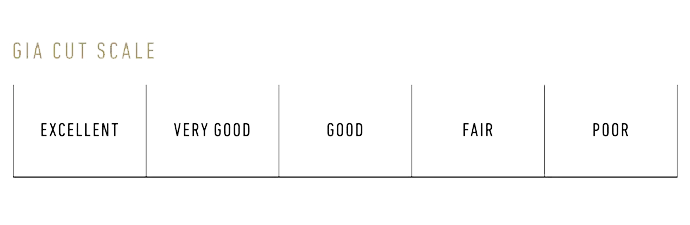
EXCELLENT (IDEAL)
The highest grade when it comes to the cut of a diamond. With an Excellent cut, the diamond has a fantastic "fire" and reflects light optimally. This cut represents the top tier of all diamonds, constituting about 3% of the market. The AGS institute is the only one that judges a diamond as IDEAL or 0, as they call it; the best cutting at GIA is Excellent.
VERY GOOD
Accounts for approximately 15% of all diamonds on the market and is a good cut. On paper, the difference between Very Good and Excellent is not always significant. However, the visual experience of the stone differs, and a Very Good cut diamond often appears smaller and darker than an Excellent-cut diamond.
GOOD
An okay cut that manages to reflect most of the light. About 25% of diamonds on the market have this cut grade. A cut of this grade is significantly less expensive than a stone of Excellent quality. The difference between a higher cut and Good is that a significant amount of light "disappears," resulting in the diamond not sparkling as much. We advise our customers against choosing this cut entirely.
FAIR Approximately 35% of all diamonds are graded as Fair. When a diamond is cut as Fair, there is a risk that much light is lost, and the ability to reflect is significantly poorer. Diamonds graded Fair are much lower priced than other cuts. Even with the naked eye, it is clear that these diamonds attain a lower quality. Diamonds with a Fair cut are often found with less scrupulous operators who prioritize offering diamonds focusing on color and clarity.
POOR
A diamond that is either too deep, shallow, wide, or narrow. These attributes cause most of the diamond's light to escape from the sides and bottom. Diamonds with a Poor cut grade are very cheap and not recommended. At VANBRUUN, we do not sell diamonds of this cut grade.
For the Curious...
There is another term in the vocabulary of cut: Heart & Arrows. Like the name suggests, hearts and arrows, this is precisely what is found in the incredibly exclusive phenomenon. Hearts & Arrows, or H&A as it is often abbreviated, is a pattern in the diamond that occurs when a diamond is cut according to a number of strict criteria. The criteria are often over the top for many, but for those seeking the best of the best, the pattern is theoretically a very good tool. To see the coveted patterns, a special tool called a Hearts & Arrows viewer is needed.
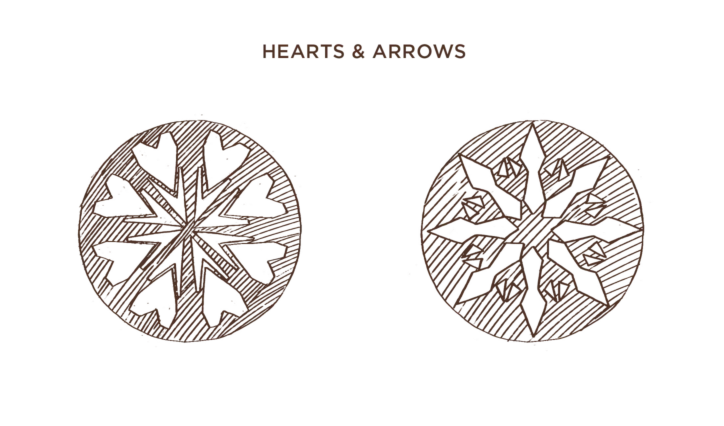
The origin of Hearts & Arrows is based on the research of the Belgian mathematician Marcel Tolkowsky. His research resulted in a couple of desirable proportions developed to cut an optimal diamond. The proportions refer to the symmetry of the diamond, which is very important, where all facets must lie in specific lines; no facet must deviate because then the light does not bounce in an ideal way, which means the diamond does not sparkle to its full potential. The pattern should be more or less perfect, and symmetry is extremely important.
Less than 1% of all cut diamonds exhibit a genuine H&A pattern. During the 1980s and 1990s, studies around the pattern were developed, leading to the addition of several tools to measure the cut grade. During this period, a tool called Firescope began to be used. Thanks to the tool, it could be seen if light from a diamond was reflected or not. Today, a newer version of Firescope is used on a variety of stones weighing over 1.0 carat. We can usually provide such images when purchasing larger diamonds.
For a diamond to be cut according to H&A, it almost always needs to meet the following requirements; those in parentheses are optimal measurements. Just because a diamond meets the following criteria does not mean it is a so-called H&A diamond. To be a genuine H&A stone, all facets must be perfect to form 8 perfect arrows and 8 perfect hearts.
Table: 53-58% (54-57%)
Pavilion angle: 40.2°-41.2° (40.6°-40.8°)
Crown Angle: 33.4°-36.4° (34°-35°)
Lower girdle halves: 75-80% (77%)
Star Facets: 45-58% (45-50%)
This table can also be helpful, but remember that there are always exceptions.
Learn more about diamonds
The 4C's
A diamond is graded by four parameters called the 4C's. Together they determine the look and price of a diamond. Read on to learn more about the 4C's.

Determine how light is reflected. This is the most critical parameter to have in mind.


Clarity (klarhet)
Describes the absence or presence of imperfections, their position, size, and origin.