




Pearl Guide
Pearls are the unique and perhaps most classic gemstone that has adorned jewelry, clothing, and accessories throughout history. This guide covers everything from the history of pearls to interesting facts about pearls and how to best care for them to ensure they shine for generations.
The History of Pearls
Pearls have been a part of jewelry and fashion history for thousands of years. Across the globe, traces of jewelry and gifts with pearls have been discovered, but pinpointing exactly when humans started wearing pearls is challenging. In ancient Persia, around 400 years before Christ, princesses' tombs contained pearl necklaces, and in the Chinese Empire, more than 2000 years before Christ, pearls were given as gifts to emperors. In Europe, during the Roman Empire, pearls were a symbol of wealth and prestige. Today, pearls are much more accessible than thousands of years ago, but their exclusive status remains, and they are perhaps one of the biggest trends of the 2020s.
Formation
Pearls form in mussels and oysters. There are various reasons for a pearl to form, but they all follow the same principle: when an object is placed or accidentally ends up inside the mollusk, it causes irritation, and the oyster or mussel reacts by producing nacre as a defense. The nacre is produced in thin layers, similar to an onion, and over time, a pearl is formed.
 (3).png)
Natural vs. Cultured Pearls
There are two different processes for producing pearls: natural pearls and cultured pearls. Today, the majority of pearls sold worldwide are cultured, which is due to the fact that mussels and oysters were previously killed in the hunt for pearls. Fishermen used to say that about one in a thousand mussels contained a pearl, but to see if a mollusk contained a pearl, they had to kill each mussel and oyster, hoping for a pearl inside. Due to this type of fishing, the world's mussel banks were almost wiped out. For about 100 years, we have been cultivating pearls, which is why they are now strongly represented in the market. Natural pearls still exist in the waters, but most natural pearls circulating in the jewelry world today are inherited or saved treasures from a bygone era.
Today, pearls are cultivated in a controlled environment. Pearls are created by placing a small bead of nacre in the mussel or oyster along with a small piece of another animal of the same species. The placed objects grow over time into a pearl. Pearls come in a wide variety of types, where price, supply, and appearance vary. Akoya pearls originate from Japan but are also cultivated in China and Vietnam. Akoya pearls are known for their fantastic white luster and round shape, making them perfect for pearl necklaces (pearl collars) and other pearl jewelry.
Grading
A pearl's value is assessed based on the type of pearl, its condition, luster, size, color, surface, shape, and nacre thickness. For pearl jewelry with multiple pearls, the overall impression of how the pearls match each other is also assessed; this term is known in English as "make." The grading scale for Akoya pearls ranges from the lowest quality A, AA, AA+, AAA to Hanadama, the highest grade, which constitutes about 1% of the world's Akoya pearls.
Maintenance
Pearls that are well cared for can last up to 150 years, but they require careful handling. We recommend the following care tips for pearls:
Do not store in cotton. Cotton absorbs oils from pearls, causing them to dry out.
Avoid contact with products like lotion, perfume, and similar.
Avoid wearing pearls when sweating.
Have pearl collars restrung from time to time.
Wipe pearls with a damp cloth to remove dirt and skin residues.
Did you know...
Fashion icon Coco Chanel once said, "A woman needs ropes and ropes of pearls." This expression increased the popularity of pearls in the 1940s across Europe.
It takes between 18 months to 2 years for an Akoya pearl to mature before it can be harvested.
Pearls are said to represent maturity, warmth, and wisdom, making them an excellent gift for yourself or someone dear.
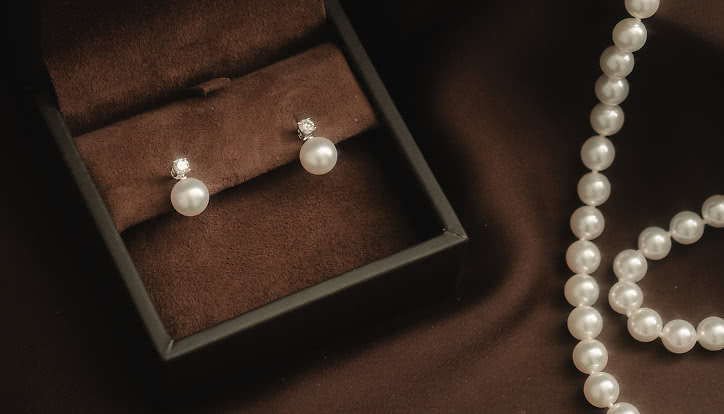


With the naked eye, it is difficult to distinguish between real and fake pearls. However, by feeling the pearl, the difference is quickly apparent. A real pearl is cool and rough, while fake pearls feel smooth and oily. An old trick still used today is to gently rub the pearl against your front teeth; if it feels rough, the pearl is real, and if it glides smoothly, it is fake.
A pearl is a biogenic gemstone created in a mussel or an oyster.
The artwork "Girl with a Pearl Earring," also known by its original title "Meisje met de Parel," was painted by Dutch artist Johannes Vermeer in 1665. The oil painting has been discussed, interpreted, and inspired both films, books, and art in popular culture.
The freshwater pearl is the most common type of pearl and is found in freshwater. As the name suggests, freshwater pearls grow in mussels.
Saltwater pearls are rarer and more exclusive than freshwater pearls. Saltwater pearls grow in oysters, and this category includes Akoya pearls found in jewelry signed by VANBRUUN.