




VANBRUUN Editorial
The pear-cut diamond: Over 500 years of design
Often mistaken for a modern innovation, the pear-cut is a timeless shape that was first introduced over 500 years ago. Throughout its long and rich history, this elegant design has graced everything from royal scepters to Hollywood legends. But the story does not end there, the world’s largest colorless diamond was crafted into this very shape. Read on to discover the fascinating heritage behind the pear-cut.
The origin of the pear-shaped diamond
While the pear-cut is often mistaken for a modern diamond cut, it was actually invented as far back as 1456 by the Flemish diamond cutter Lodewyk van Bercken. That same year, he introduced a revolutionary diamond polishing wheel. An invention that made it possible to master complex cuts and polish facets with the perfect symmetry that still defines the brilliant pear-cut today.
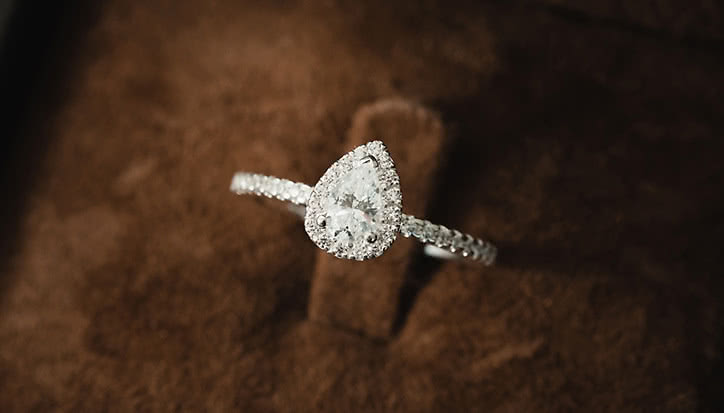
The world's largest colorless diamond: The Great Star of Africa
In 1905, a majestic 3106 carat gem-quality rough diamond was discovered in Cullinan, South Africa. The difficult task of cutting the diamond fell to Joseph Asscher & Co, an intense process that eventually resulted in nine major diamonds and 96 smaller brilliants.
The most magnificent of them all, Cullinan I, is a pear-cut diamond featuring 74 facets and an incredible weight of 530.2 carats. Also known as the Great Star of Africa, it remains the largest colorless cut diamond in the world. If you want to see it for yourself, it holds its place of honor within the Sovereign’s Sceptre with Cross, as a central piece of the British Crown Jewels.
The famous Taylor-Burton diamond
As a gift from her fifth husband, Richard Burton, Elizabeth Taylor received a 69.42 carat diamond after an intense bidding process. When the diamond arrived in New York, and Burton went to collect it, the gem caused such a sensation that crowds lined the streets just to catch a glimpse of its brilliance.
Following the couple’s divorce, Elizabeth Taylor selflessly auctioned off the diamond, using the proceeds to build a hospital in Botswana. Today, the Taylor-Burton diamond is held in a private collection and has remained out of the public eye, yet it remains one of history’s most celebrated diamonds.
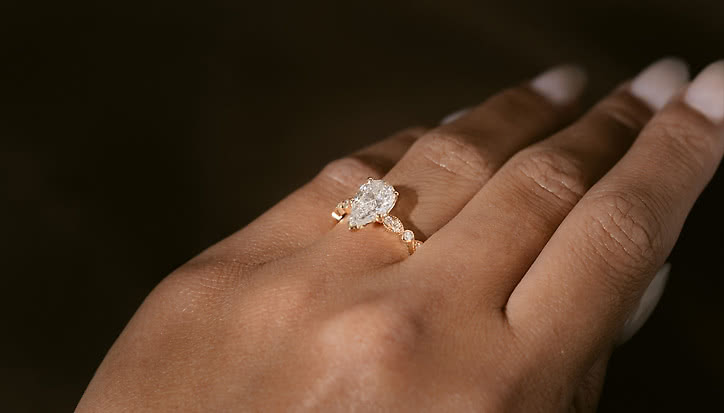
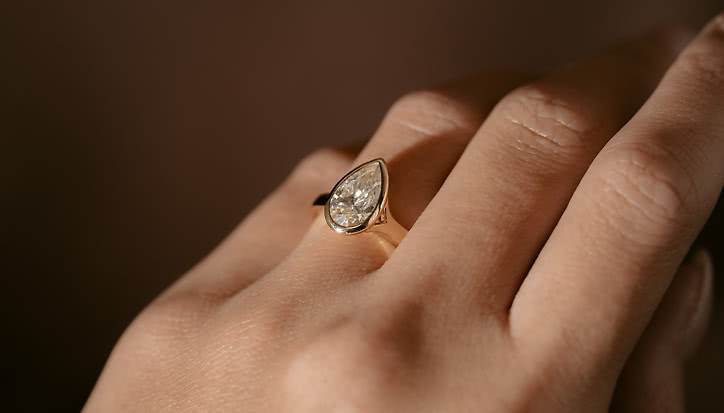
A pear-cut diamond can be worn in whichever direction you prefer. While it is traditionally styled with the point facing the fingertip, turning it toward the wrist offers a personalized look.
For diamonds under 1.0 carat, we recommend a color grade between I–D, while stones over 1.0 carat should remain within the G–D range to ensure the diamond does not appear dark. To achieve the best value in smaller stones, SI1 clarity is an excellent choice; however, for larger diamonds, we suggest VS2 to guarantee an eye-clean appearance. Regarding the cut, prioritize excellent or very good symmetry, paired with a depth of 58–62% and a table of 53–63% for optimal performance.
An excellent ratio for a pear-cut diamond is between 1.45-1.55.
The 69,42 carat diamond is held in a private collection and is no longer on public display.
Pear-cut diamonds are sometimes called teardrop diamonds as they resemble the silhouette of a droplet of water.