



VANBRUUN Editorial
Clean lines and quiet luxury: The history of the emerald-cut diamond
Since the emerald-cut’s roots stretch back to the 16th century, it has long been cherished by those who value clean lines and understated sophistication. However, it was during the Art Deco era that this geometric shape truly found its form, transforming it into the timeless design we know today. Since then, it has become a beloved favorite among celebrities, perhaps most famously exemplified by Grace Kelly's engagement ring.
The history of the emerald-cut diamond
The emerald-cut diamond draws its name from the traditional shape originally developed for emerald gemstones. As cutting techniques evolved during the 16th century, the risk of chipping was significantly reduced, allowing the cutters to safely master this elegant, rectangular form. We are fortunate that they did, as it has allowed us to continue enjoying one of the oldest and most sophisticated diamond silhouettes in history.
However, transforming a rough diamond into a perfect emerald-cut is still a craft that requires immense precision. Due to its open step-cut facets and large table, any internal imperfections are much easier to spot, unlike in more forgiving brilliant cuts.
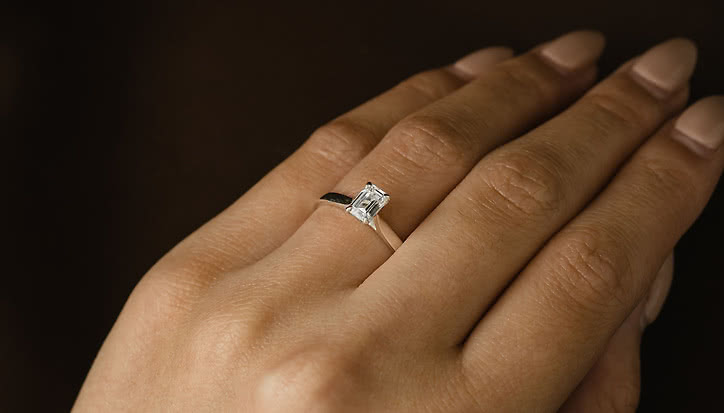
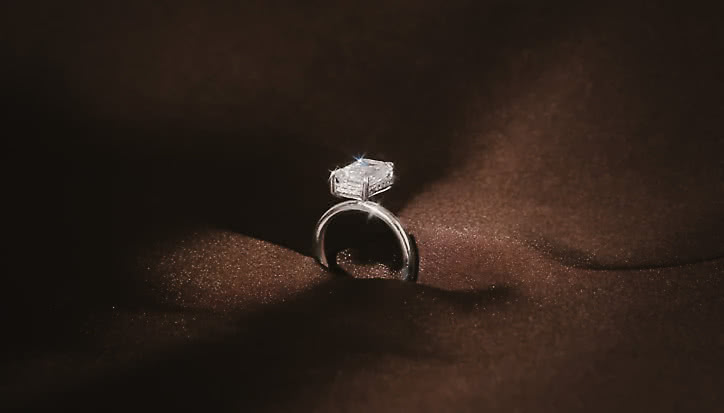
The Art deco icon
During the Art deco era, the shape truly surged in popularity, celebrated for its clean lines and perfect symmetry. In fact, it was not until this period that the term "emerald-cut" was formally adopted. The cut quickly became a symbol of sleek elegance, favored in both engagement rings and fine jewelry. Today, it remains a timeless choice, still carrying the same sophisticated characteristics that made it an icon a century ago.
From Hollywood to royalty
The popularity of the emerald-cut continued long after the Art Deco era. Its status was further established when Grace Kelly received a 10.48 carat emerald-cut diamond with baguette sidestones from Prince Rainier III of Monaco. Her ring remains one of the most recognized designs in history, serving as inspiration for generations of celebrities, including Elizabeth Taylor, Beyoncé, and Anne Hathaway.
Are you also inspired by Grace Kelly’s timeless style? Our three-stone ring Elly captures this classic look perfectly when paired with an emerald-cut center stone.
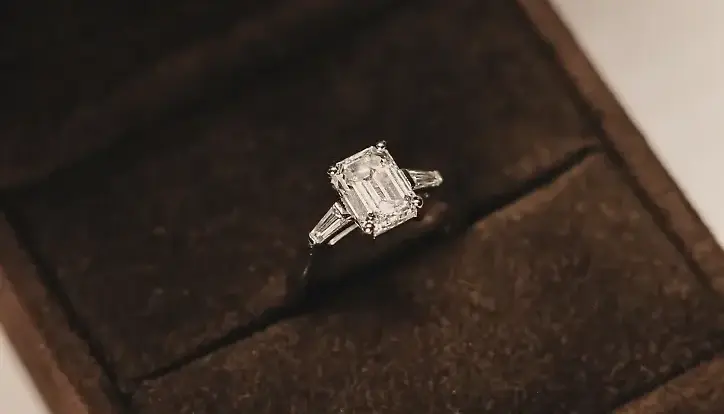
Since emerald-cut diamonds are defined by a step-cut they have a smooth, glass-like shimmer, instead of a high level of sparkle as a brilliant cut diamond.
While both share a similar shape, the emerald cut has parallel facets that create a sleek, mirror-like elegance, whereas the radiant cut has brilliant facets designed for maximum sparkle.
For emerald-cut diamonds, VANBRUUN recommends a color grade of G–D for stones under 1.0 carat, and F–D for those above. To ensure an eye-clean appearance, we suggest a clarity of VS1–VS2 or higher for diamonds under 1.0 carat, while VVS2 is recommended for larger stones. As the GIA does not provide an official cut grade for emerald-cuts, we recommend selecting a diamond with a depth and table between 60–69% for optimal beauty. This should be paired with polish and symmetry graded from good to excellent, depending on your budget.
For a square emerald-cut diamond the excellent ratio is 1.00-1.03, and for rectangle emerald-cut the best ratio is 1.40-1.50.
An emerald-cut diamond’s size varies depending on various factors, for example its carat weight. To see the size chart, click here.