







VANBRUUN Guide
Does the diamond certificate matter?
Does the diamond certificate matter? Yes — the grading institute behind a diamond can impact both price and quality. Certificates from GIA and AGS are the most reliable, while others like EGL and IGI may overgrade diamonds. This guide explains the differences between major grading labs, why similar diamonds can vary in price, and what to consider before making your purchase.
Why do equal diamonds differ in price?
We often get the question of why there is a certain price difference between two similar diamonds, seen to the diamond's specifications. This may be related to which certification institute that has certified the diamond. One question to ask yourself in these situations is, therefore "Are both diamonds certified by the same institute?" If the answer is no, you should read on.
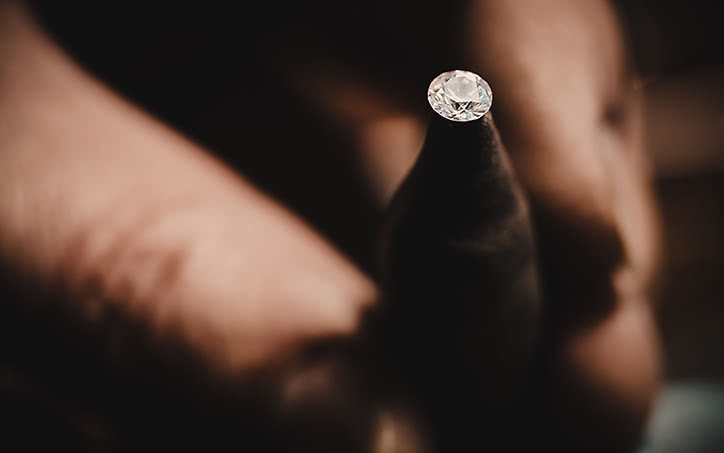
Comparison of different grading institutes
In the diamond industry, there are institutes that are more and less serious. That is the institutes that are consistent, credible and have a good reputation while there are more inconsistent and less reputable institutions in the industry.Below you can read briefly about the four largest institutes in the world.
GIA (Gemological Institute of America)...
... is the world-leading gemological laboratory and has a very good reputation worldwide. GIA is behind the world-renowned grading system "The Four Cs" that several other institutions have followed. GIA has offices worldwide and employs over 1,400 researchers, trainers, and certified gemologists. Headquartered in Carlsbad, California. Diamonds graded by GIA are examined by four or more gemologists before the certificate is issued, this leads to consistency. In addition to grading gems, GIA also offers training and research, to be able to offer the latest discoveries in the rapidly changing technology in the diamond industry.
AGS (American Gemological Society)...
... is also an American laboratory with headquarters in Las Vegas. **The AGS is known for its scientific approach and research in diamond grading. **Instead of using the alpha grading system (like GIA), AGS uses a 0-10 scale when grading a diamond's trait where 0 is the best and 10 is the worst. AGS is also known for its ethical standard and consistency in its rating system. In the US, AGS is the second largest after GIA, but today it is found all over the world.
EGL (European Gemological Laboratory)...
... is a European grading institute but is today found all over the world. EGL run different business in different countries, For example, EGL Europe, EGL Canada, EGL Israel and EGL USA where the last one is the one with the best reputation. All are known for their pioneering grading technique for diamonds under 1 Carat, for example, that they show the diamond's Hearts & Arrows pattern on the diamond's certificate. Unfortunately, they are also notorious for the introduction of what they call SI3 diamonds. Today they have a large market share in Europe. EGL certificate retailers often claim that "Why pay more for a GIA diamond when quality is the same as with an EGL certificate? You pay for a piece of paper ”. Both EGL and GIA are based on the classification terminology around the four Cs, unfortunately, the standards are very different between the different institutions.
IGI (International Gemological Institute)...
has its headquarters in Antwerp, Belgium. They are generally the second most well-known lab in the world, after GIA. A significant proportion of polished diamonds on the market are graded by IGI and they are very popular in Asia. Generally speaking, they are considered less serious than both GIA and AGS. They do have a good reputation when it comes to lab-grown diamonds and grading colored diamonds though.
Pay attention
When you do your research and look around for diamonds on different websites or physical stores, the price is probably a factor that governs your search a lot. Pay attention and ask yourself how two diamonds with the same specifications can differ significantly in price. You will be able to clearly see that diamonds issued by EGL are significantly lower in price than those with certificates from GIA and AGS. It is important to remember that you won’t make a good deal, the risk is instead that you buy a diamond of lower quality than you wish. It just seems that you have to pay less for an equivalent diamond when the cheaper diamond, in fact, has a lower quality than what is stated on the certificate.
A difference in assessment - a risk of overgrading
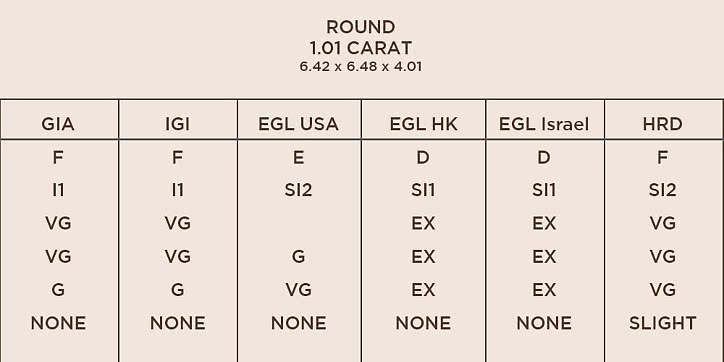
The difference in grading standard obviously entails some differences in diamond grading results. IGI and EGL overgrade diamonds, giving the customer a false sense of quality and value. To easily explain it, one could say that EGL and IGI generally grade up to two steps better than GIA and AGS.
Let's say that GIA would grade a 1 Carat diamond to the color H and clarity SI1, the same diamond can get the grade F in color and VS1 in clarity from EGL. The objective factors in terms of weight and cut where mathematical formulas are behind they are consistent but with the more subjective factors like clarity and color, it can distinguish a lot where GIA usually is the tougher of the two. This example summarizes quite well why one should not compare diamonds with certificates from different grading institutes.
Great demands on the customer
As a customer, it is important to understand that there are some differences between different grading institutes. All labs use different grading systems, terminologies and are more or less consistent. One result of this is that a certificate from one institute can show other results compared to another.
Today, many suppliers around the world offer diamonds with certificates from other institutions than GIA. The explanation is partly that their certification cost will be lower and that they, therefore, can offer their diamonds at a lower price than if they had chosen GIA. Since there are few rules today that regulate the certification processes, it gives you as a customer responsibility to understand the reasons for the difference between different grading institutions. It places great demands on you to know the difference between their reputation, experience, consistency, and credibility in order for an informed decision to be made.
Certificates are not the same as a valuation document
Also one of the world's largest insurers writes that the most reliable certificates are issued by GIA and AGS. These are the most respected laboratories, known for their accuracy and professionalism. Certificates are grading reports and should not be mistaken for diamond valuations. Certificates from laboratories other than GIA and AGS are often questioned and should not be invoked by insurers.