



VANBRUUN Guide
Diamonds
Everything you need to know about diamonds in five minutes.
Everything you need to know about diamonds in five minutes. This guide breaks down the four Cs — carat, clarity, color, and cut to help you understand what impacts a diamond’s appearance, quality, and value, so you can make a confident and informed decision when purchasing a diamond.
Carat
Carat is probably the term most people are familiar with when it comes to diamonds.
WEIGHT
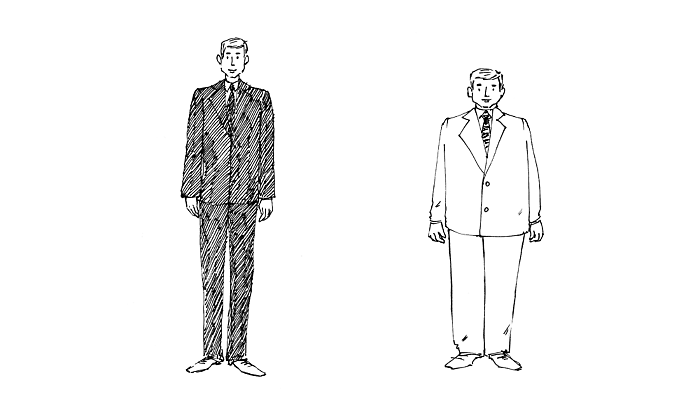
Carat is a unit of weight and 1 carat corresponds to 0.2 grams. Weight is not the same as size. This can be compared to two people of the same weight, they probably look different, the same goes for diamonds. A diamond weighing 1 carat does not have to have the same measurments as a diamond of an equal carat weight.
HISTORY OF THE WORD CAROB
The word Carat is derived from the word carob which means carob tree. In the past, these seeds were used as a counterweight to diamonds when weighing them, because the seeds always seemed to have the same weight. The carat has been the standard unit for weighing diamonds since the early 1900s.
PRICING
All other things being equal, a larger diamond is always more expensive than a smaller one. Sometimes you talk about the price per carat, where you calculate this by taking the carat weight divided by the price. If you do this, you will soon notice that a diamond of, for example, 2 Carat is more than twice as expensive as one that weighs 1 Carat. This is because the price rises exponentially. Larger diamonds are significantly rarer than smaller ones.
KARAT AND CARAT
Carat should not be confused with karat, karat stands for the percentage of gold in a piece of jewelry. For example, 18 or 24 karat gold. This is spelled with K while the Carat of diamonds is spelled with C.
VANBRUUN guide
Carat is a unit of weight and should not be confused with size. Do not focus on carat as the only criterion. A diamond with a smaller carat can be perceived as larger than one with a higher carat. Instead, focus on the cut.
Clarity
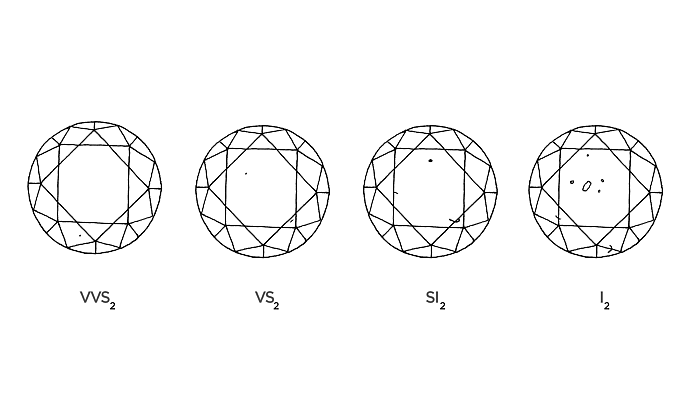
Describes the absence or presence of imperfections, their position, size, and origin. The scale ranges from FL (Flawless) to I3 (Included 3). FL means no inclusions can be spotted while magnifying x10, while I3 means many inclusions can be spotted with the naked eye.
WHAT INFLUENCES THE GRADING?
When grading a diamond's clarity, one studies the number of defects, size, location and type of inclusion. These factors determine how a diamond's clarity is graded.
DIFFERENT CONCEPTS
When talking about a diamond's clarity, concepts such as eye clean, visible with 10x magnification, etc. are used. Thus, a distinction is made between inclusions that can be easily detected by just studying a diamond with the eye and the inclusions that can first be detected with help by
VANBRUUN guide
Ask yourself what is important to you. If you want a very high grade of clarity, then choose a diamond graded VVS or higher. If you are satisfied with a diamond that is free from inclusions when observed by the naked eye, you can select a diamond graded between VS2-SI1.
The scale
The scale extends from Flawless (diamonds completely without inclusions) down to I3 (very clear inclusions without aids).
I1-I3
These diamonds have large visible inclusions that can be clearly seen with the naked eye.
SI1-SI2
These diamonds have inclusions that in some cases can be detected with the naked eye, without any aids. These diamonds are very affordable and have all the potential to be stunning.
VS1-VS2
Diamonds with this clarity have inclusions that can be seen with 10x magnification but are in most cases 100% pure to the naked eye. This depends entirely on the size and shape of the diamond, the larger the diamond, the easier it is to distinguish inclusions.
VVS1-VVS2
These diamonds have very, very few and tiny inclusions that are difficult to detect, even under magnification.
FL-IF
Diamonds that are flawless have no imperfections, neither external nor internal. IF is without internal imperfections. Both of these are extremely rare and those who choose this clarity often do so for its clinical designation on the certificate and its rarity.
Our experts advice
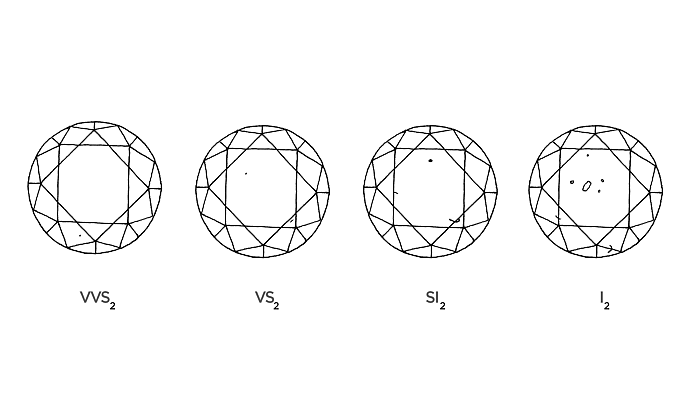
We recommend SI1 (Slightly Included 1) as the lowest if you are looking for a diamond that is free of inclusions visible to the naked eye. It is important to remember that all diamonds graded SI1 are not 100% pure to the naked eye. As with everything, you get what you pay for. If a diamond is "too good to be true", there is probably a defect with it, we will be happy to help you handpick a diamond that is clear to the naked eye.
If you plan to buy a shape other than round, you generally need to go up a bit in quality because inclusions are more exposed in, for example, asscher-cut or emerald-cut diamonds. The same applies with size, the larger the diamond, the higher grade clarity should be chosen.
Color
When discussing color in colorless, naturally white diamonds, one speaks more of the absence of color. Most diamonds often have some form of hue that tends towards the warmer side. There's nothing that says one color is better or worse than another; this is one of the four Cs where personal preference carries significant weight.
Color in colorless diamonds is assessed on a scale from D to Z, where D-E is considered completely colorless, and F-H are partially colorless, with more color present as you move further down the scale. Z has a strong yellow color but still qualifies as a colorless diamond as it is not yellow enough to be classified as a fancy colored diamond.
When assessing color in fancy colored diamonds, entirely different scales are used.
SWEDEN
In the Nordic countries, diamonds are classified according to their own standard ranging from River to Yellow. Unfortunately, this can be a bit confusing for us consumers as D is the same as River and H is equivalent to Wesselton.
COLORLESS
If you wish to purchase a diamond that is completely colorless to the naked eye, we recommend choosing one with a color grade of H or higher. Many seeking diamonds with grades D-F often pay for the clinical designation, meaning the rarity of a diamond being as colorless and icy as possible. However, many see no difference at all between diamonds in the range of D-H as long as they are not placed directly next to each other.
We only sell diamonds in the range of D-K because the demand for stones with lower color is very small, and customers who desire a warmer color often opt for a colored diamond instead, such as a brown or yellow diamond.
BE ATTENTIVE
It is important to keep in mind that a color classification by one certification institute doesn't necessarily correspond to the same color with another. For this reason, it is crucial to be attentive and choose a diamond certified by the more meticulous and reputable institutes. A diamond certified by a less reputable institute may be graded as a G, while a more reputable institute such as GIA and AGS might assess it as an I. Therefore, always demand an independent certificate when comparing different diamonds.
VANBRUUN guide
A tip when choosing a diamond is to consider the metal of your ring. If you're planning to buy a ring in yellow gold, rose gold, or red gold, you can advantageously go down slightly in color and choose a warmer stone. This is because the band will naturally reflect a certain warm hue onto the stone. Many of our customers opt for diamonds with color grades I-K if they are planning to buy a ring in a metal other than white gold or platinum.
Cut
Diamond cut refers to how well the facets (the different parts of the diamond) are polished.
BRIGHTER AND LARGER
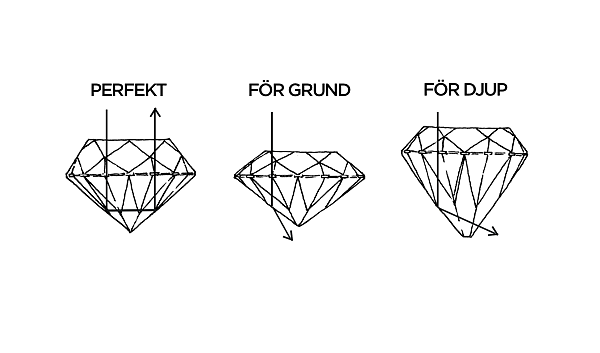
At VANBRUUN, we believe that a diamond's cut is one of the most important factors to consider when choosing a diamond. This is because a well-cut diamond not only appears larger but also reflects more light, making it appear more vibrant than a poorly cut diamond.
PROPORTIONS AND SYMMETRY
Several factors influence the grading of a diamond's cut, but important factors to look out for are the stone's proportions and symmetry. Proportions refer to the diamond's measurements to determine how well its facets are aligned. Many find this aspect complex and may consider it advanced. Therefore, it's essential to carefully examine the diamond's certificate and consult with someone knowledgeable before making a decision.
The scale
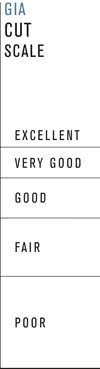
The cut is assessed on a scale from poor to Excellent. I'll briefly go through the different stages to give you an idea.
Poor These diamonds are very low-priced and are not something we recommend. The essence of having a diamond is unfortunately lost with this cut as they are very dark and asymmetrical. Diamonds with this cut are uncommonly set in jewelry.
Fair A lot of light is lost, and the ability to reflect light is very poor. It's also noticeable to the naked eye that diamonds with this cut are not nearly as good as those with better cuts. These diamonds end up with less meticulous operators who prioritize selling color and clarity as the important factors.
Good Approximately 25% of all diamonds have this cut. It's an affordable diamond. Unfortunately, quite a bit of light is lost, and the sparkle is usually poor in these diamonds. They are also smaller than those with better cuts due to how the carat weight is distributed.
Very good Accounts for approximately 15% of all diamonds and is a very good cut. However, if you want to maximize size and sparkle, you should consider a better cut. Very good is not something we recommend.
Excellent A perfectly cut diamond that reflects maximum light. Better cutting than this cannot be found. The diamond's sparkle and fire are unparalleled. These diamonds represent the top tier of all diamonds and account for about 3% of all polished diamonds.
VANBRUUN guide
Never compromise on the cut quality, if you wish to lower the price, we recommend you lower the quality of the other parameters. The cut quality is absolutely the most important.